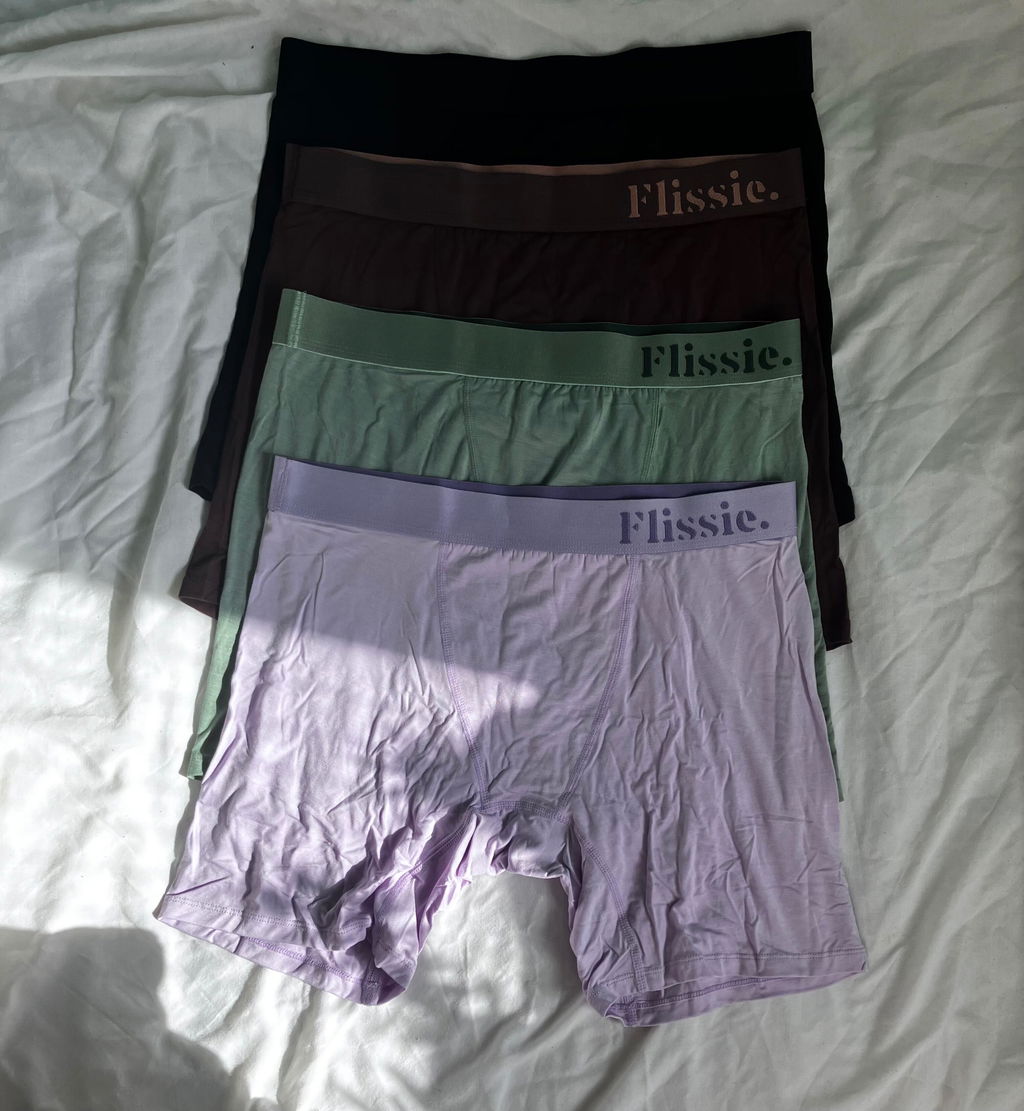
Updated 21 October 2026. We make Flissie women's bamboo boxer shorts, so read this guide to groin sweat and excessive sweating in the groin area with that in mind. The medical advice below comes from the NHS, the Primary Care Dermatology Society (PCDS) and the British Association of Dermatologists (BAD), quoted wherever we could and checked on 21 October 2026. We are not doctors, and nothing here replaces a GP or a pharmacist.
Groin sweat is normal. Sweating is how your body cools down, and the groin is warm, covered and a place where skin touches skin. Some people call the result swamp crotch. Below: why it happens, what to wear, and the signs that mean a GP rather than new knickers.
Groin sweat in women: the quick answer
Groin sweat happens because sweating is how the body cools down, and the groin is a warm, covered fold where skin rests on skin. Most of the advice on what helps is about clothing: loose clothes, no synthetic fabrics such as nylon, and an absorbent layer next to your skin. The NHS says to “wear loose-fitting clothes to minimise signs of sweating” and not to wear tight clothes or synthetic fabrics, and the PCDS and the BAD both point to “absorbent underlayers such as cotton T-shirts”. None of the three mentions the groin, but we apply the same advice to a sweaty crotch, sweaty inner thighs and a sweaty bum.
For the layer next to your skin, our pick is Flissie women's bamboo boxer shorts (we make them), for three reasons you can check. They are 95% bamboo viscose and 5% elastane: bamboo viscose is a man-made cellulose fibre, not nylon or polyester, and while the NHS and the PCDS advise against nylon and synthetic fabrics, neither mentions viscose. The 6 or 9 inch leg keeps fabric between your inner thighs, so skin is not resting on skin (most women's boxer shorts stop at 2 to 4 inches). And they are seamless at the back and sides, with a flat seam at the front, so no seam sits in the cleft of your bum.
Other options, by need: loose cotton knickers for thrush or heat rash, because the NHS names cotton for both; a polyester sports pant for a soaking gym session, because it dries faster; and a GP if the sweating stops you getting on with your daily activities.
Flissie women's bamboo boxer shorts
£13.50 a pair, the same price in every size from UK 8 to 30. Buy 6 for £75 (£12.50 each) or 10 for £115 (£11.50 each), and the 10 pack comes with a free 30 day tub of our perimenopause supplement (worth £29). 95% bamboo viscose and 5% elastane, with a 6 or 9 inch leg, seamless at the back and sides. Free UK delivery on every order and a 60 day guarantee: full refund, worn or not (return postage at your cost), or a free size swap on your first order. We cut our prices in November 2026 and do not know how long we can hold them.
Why does the groin sweat so much?
Because sweating is how you cool down, and the groin is a warm, covered skin fold, the kind of place the PCDS describes as one where “air circulation is limited”. The PCDS explains that “when we overheat, we sweat without thinking about it to lower our body temperature.” The BAD puts it simply: “Sweating is a normal response to a rise in body temperature, and to emotions such as anxiety.”
None of the three bodies singles out the groin in its sweating advice. The PCDS guidance on intertrigo, a rash of the skin folds, describes “moisture trapped in deep skinfolds where air circulation is limited” and says intertrigo “is most commonly found in the groin, axillae, and inframammary folds” (the armpits and under the breasts). The inner thighs and the cleft of your bum are folds too, so the same clothing advice applies.
Why some women sweat more than others
Some women simply sweat more, and usually nobody knows why. The PCDS says: “In most cases the reason some people sweat more than others is unknown, and this is called primary hyperhidrosis, which tends to start in adolescence or even earlier in childhood.” The NHS says: “Excessive sweating can happen for no obvious reason, because of another condition you may have, or as a side effect of a medicine you're taking.”
The BAD leaflet adds that “Sweating all over can be without a cause or can be caused by some illnesses including infections”, and names hormonal conditions including “the menopause, diabetes, and an overactive thyroid gland”. It also says “Some medicines can also cause the problem, including fluoxetine and similar antidepressants”, and that “Anxiety can worsen sweating, and so worrying about sweating can make the problem worse.” For night sweats, the NHS lists menopause symptoms (“hot flushes”) among the most common causes.
Day to day, the NHS names tight clothes and synthetic fabrics as things not to wear, and gives drinking alcohol or eating spicy food as examples of things that “might make your sweating worse”. For people prone to sweat rash in skin folds, the PCDS adds: “Patients should be warned about heat, humidity, and outside activities.”
Excessive sweating in groin area: when to see a GP
See a GP if you are sweating excessively and any of the NHS's own reasons apply. The NHS says to see a GP if you're sweating excessively and:
- things you can do yourself are not helping
- it's lasted for at least 6 months
- it stops you from getting on with your daily activities
- it happens at least once a week
- it happens at night (you're having night sweats)
- you have a family history of excessive sweating
- you're taking medicine for another condition
For night sweats, the NHS night sweats page says to see a GP if:
- you have night sweats regularly that wake you up or worry you
- you also have a very high temperature (or feel hot, cold or shivery), a cough or diarrhoea
- you have night sweats and you're losing weight for no reason
The NHS says a GP “may refer you for tests if they think another condition may be causing your sweating”. If you are referred to a dermatologist, the treatments the NHS lists include tablets that reduce sweating, a cream you put on your skin, iontophoresis (a weak electric current passed through water or on a wet pad), botox for the armpits and surgery. Before any of that, a pharmacist can help: the NHS says they can suggest stronger antiperspirants. If you are thinking of using an antiperspirant on groin skin, ask the pharmacist first.
How to stop groin sweat building up: what to wear
You cannot stop your groin sweating, and you would not want to, because it is how you cool down. What you can change is what you wear: the NHS, PCDS and BAD all advise loose clothes, and the NHS and PCDS steer you away from synthetic fabrics such as nylon. Here is their hyperhidrosis clothing advice, word for word:
- NHS: “wear loose-fitting clothes to minimise signs of sweating”, and “do not wear tight clothes or synthetic fabrics” (it gives nylon as the example).
- PCDS: “wear loose-fitting clothes made from natural fibres, as opposed to synthetic fabrics such as nylon.” And: “Absorbent underlayers such as cotton T-shirts may help”.
- BAD: “Absorbent underlayers such as cotton T-shirts (wicking fabrics) can help hyperhidrosis of the body.” And: “Loose fitting clothes made of natural fibres and leather shoes/sandals are also beneficial.”
- PCDS, on sweat rash in skin folds: “Patients should wear light, non-constricting, and absorbent clothing and avoid nylon and other synthetic fibres.”
The BAD adds a tip for sweat that shows through: “Some colours show sweat more than others (white and black are better than blue, for example).”
The catch: underwear is not loose
The NHS says loose, and underwear cannot be loose the way a skirt can: knickers sit against your skin by design. So read the advice as two layers. Keep the outer layer loose: a skirt, a dress or wide-leg trousers rather than tight jeans or leggings. Then make the layer against your skin an absorbent one: the PCDS and BAD give cotton T-shirts as their example of an absorbent underlayer, and both favour natural fibres (the PCDS contrasts them with synthetic fabrics such as nylon). If your thighs touch, a longer leg keeps fabric between sweaty inner thighs instead of skin on skin.
Our own fabric fits this advice awkwardly, so to be plain: ours is 95% bamboo viscose and 5% elastane. Bamboo viscose is a man-made cellulose fibre, neither a natural fibre nor nylon or polyester; the elastane is synthetic; and none of the three bodies mentions viscose.
Which fabric is best for groin sweat?
No clinical body ranks underwear fabrics for sweat, but the advice points one way: absorbent next to the skin, and not nylon or other synthetic fabrics. Cotton is what the NHS names for heat rash and thrush. Viscose holds more moisture than cotton: 11% against 7% in the moisture regain figures below. Polyester holds very little moisture and dries quickly, one reason sportswear uses it, but polyester and nylon are synthetic fabrics, which the NHS and PCDS tell you to avoid.
| Fabric | What it does with moisture | Drying | What the NHS, PCDS and BAD say | National Eczema Society |
|---|---|---|---|---|
| Bamboo viscose (what Flissie boxers are made of) | Absorbent. Viscose (rayon) has a moisture regain of 11%, and “Viscose fibres have good absorbency” | Slower than polyester: cellulose fabrics “take longer time to dry” | Not mentioned. It is a man-made cellulose fibre: not one of the natural fibres the PCDS and BAD recommend, and not the nylon the NHS and PCDS warn against | Describes bamboo fabric in general as “more absorbent than cotton”, and says the processing of bamboo viscose “is chemically intensive” |
| Cotton | Absorbent. Moisture regain 7%; it “absorbs perspiration, but it saturates quickly” | Slower than polyester (also a cellulose fabric) | NHS: “Wear loose cotton clothing” for heat rash and “wear cotton underwear” for thrush. PCDS and BAD: absorbent underlayers such as cotton T-shirts | “great at absorbing sweat” |
| Polyester | Holds very little. Moisture regain 0.4% | “quick drying”, one reason sportswear uses it | A synthetic fabric: the NHS says do not wear synthetic fabrics, and the PCDS says avoid synthetic fibres | Many people with eczema find it causes “overheating, sweating and irritation” |
| Nylon | Holds less than cotton. Moisture regain 4.5% | Not covered by our sources | The NHS's own example of a synthetic fabric not to wear, and named on both PCDS pages | Many people with eczema find it causes “overheating, sweating and irritation” |
| Merino wool | Very absorbent. Wool moisture regain 13.6%; merino “can absorb up to 35% of its dry weight in moisture vapour” | Superfine merino has “quick drying properties” | Not named. Wool is a natural fibre, which the PCDS and BAD favour | Many people with eczema find wool causes “overheating, sweating and irritation” |
We list bamboo viscose first because it is what we use, not because any clinical body ranks it first. Moisture regain is how much moisture a fibre holds from the air, as a share of its dry weight. The figures are the ASTM D1909 values in a Manchester Metropolitan University sportswear chapter by Praburaj Venkatraman, and they describe fibres, not any brand's underwear, ours included. Absorbing more is not the same as drying faster: the same chapter says cellulose fabrics, which include cotton and viscose, “tend to absorb water within its fibre structure and become heavy and take longer time to dry.” The last column is from the National Eczema Society factsheet.
What to wear for groin sweat at work, in the heat, at the gym and in bed
The same two layers work almost everywhere: loose on the outside, breathable and absorbent against your skin. The gym is the exception, where a fast-drying synthetic can make more sense. For how to stop crotch sweat showing through trousers, start with the outer layer: the NHS says loose-fitting clothes minimise signs of sweating, and the BAD says white and black show sweat less than blue.
| Situation | Outer layer | Against your skin | Read more |
|---|---|---|---|
| At work | A skirt, a dress or wide-leg trousers rather than tight trousers. White or black rather than blue, if sweat shows. | A breathable, absorbent pair that is not nylon or polyester, with a longer leg if your thighs touch when you sit. | Shorts for under dresses that stay put |
| Hot weather | Loose and light. The NHS heat rash advice is “Wear loose cotton clothing.” | A 6 or 9 inch leg, so sweaty thighs have fabric between them rather than skin on skin. | Chub rub: how to stop it and sweat wicking underwear compared |
| At the gym | Whatever you train in. | For a soaking session, a polyester sports pant dries faster than cotton or bamboo viscose. Get out of damp kit afterwards: the PCDS advice for skin folds includes keeping them “clean and dry”. | Gym underwear: what to wear under leggings and shorts |
| In bed | Light bedding: the NHS heat rash page says “Use lightweight bedding.” | Loose sleep shorts, or a breathable boxer you can sleep in. The NHS says to see a GP if night sweats regularly wake you up or worry you. | What to wear to bed and menopause nightwear compared |
If your night sweats come with perimenopause, our guide to perimenopause, hot flushes and your underwear goes further, and the NHS reasons to see a GP above still apply.
Sweaty bum: why it happens, and what to wear
A sweaty bum crack happens for the same reason as groin sweat: the cleft between your buttocks is a fold where skin rests on skin, warm and covered for most of the day. The same clothing advice applies. One addition of ours, from making underwear rather than from the NHS: keep fabric out of the cleft. A thong sits in it by design, and briefs that ride up end up there. One reviewer in the United Kingdom came to boxers “fed up of picking pants out my backside”.
So for bum sweat, look for a seat that covers the whole bum, no seam running down the middle of the back, and a fabric that is not nylon or polyester. Flissie women's bamboo boxer shorts are seamless at the back and sides, with a flat seam at the front, so there is no seam in the cleft, and for most reviewers the seat stays put. Louise, United Kingdom, “liked the fact that the seams are in a different place to normal pants”. Not every pair, on every body, every day, though:
“You will still get the boxers ride up to wedgie slightly but it is nothing compared to a wedgie from a standard brief.”
Jasmine, United Kingdom, on Flissie women's bamboo boxer shorts
Beyond underwear, the general advice applies: loose trousers or a skirt over the top, and keeping the area “clean and dry”, as the PCDS puts it for skin folds. If the skin in the cleft turns red, sore or itchy, see a pharmacist rather than guessing what it is.
When groin sweat turns into a skin problem
Four skin problems are worth knowing about when the groin stays warm and damp: sweat rash (intertrigo), heat rash, a fungal infection and thrush. A pharmacist is the first stop for all four, and a GP if it is your first time with thrush or a rash does not get better. We will not try to tell them apart for you; a pharmacist can.
| Problem | What the NHS or PCDS says | First stop |
|---|---|---|
| Sweat rash (intertrigo) | PCDS: “Intertrigo is an inflammatory condition of the skin folds caused by skin-on-skin friction.” NHS Wales: it “develops in areas where skin rubs against other skin, such as the armpits, groin and under the breasts”, and is “a red rash that might be less noticeable on brown and black skin”. | A pharmacist |
| Heat rash | NHS: “Heat rash is usually caused by sweating a lot.” “Wear loose cotton clothing.” “Do not use perfumed shower gels or creams.” | A pharmacist; a GP if “you have heat rash that does not improve after a few days” |
| Fungal infection, such as jock itch | NHS: ringworm can appear on the “groin (jock itch)”. NHS Wales: “wear loose-fitting clothes made of cotton or a material that keeps moisture away from your skin”, and “wash the affected skin every day and dry it carefully afterwards, especially in the folds”. | NHS: “Speak to a pharmacist first if you think you have ringworm.” NHS Wales: a GP if “you've treated your rash for 1 week but it has not got better, or it's getting worse” |
| Thrush | NHS: it “tends to grow in warm, moist conditions”; “wear cotton underwear”; “do not wear tight underwear or tights”. | A GP if “you have symptoms of thrush for the first time”; otherwise, “A pharmacist can help with thrush” |
For heat rash and thrush the NHS names cotton, and our boxers are not cotton, so follow the NHS until it settles; our article on bamboo underwear and thrush looks at what the evidence does and does not say. Skin rubbed raw between the thighs is chafing, which our chub rub guide covers in full; a longer leg is aimed at the rubbing, and it will not stop the sweat. If you feel very ill with a rash, the NHS Wales leaflet says to go to A&E or call 999.
Flissie women's bamboo boxer shorts: our pick for the layer against your skin
Best for: a long-leg layer against your skin when your thighs touch, in UK 8 to 30.

We are Phillippa and Matthew, and we run Flissie from Derbyshire, so read this section knowing it is about our own product.
- Fabric: 95% bamboo viscose and 5% elastane. Bamboo viscose is a man-made cellulose fibre, not nylon or polyester. A breathable, moisture-wicking, temperature-regulating fabric, dyed to OEKO-TEX Standard 100.
- Leg: 6 inch, which sits mid-thigh (every colour and size), or 9 inch, which sits just above the knee (black and pine green, in every size from UK 8 to 30). Either way there is fabric between your inner thighs; most women's boxer shorts stop at 2 to 4 inches.
- Construction: seamless at the back and sides, with a flat seam at the front, so no seam sits in the cleft of your bum. No tag.
- Waistband: a mid-high, wide, flat waistband rather than a narrow band of elastic; if you would rather it sat above a fuller tummy, size up.
- Sizes: S to 3XL, UK 8 to 30, the same price in every size, with the leg opening and waistband graded separately rather than scaled up.
- Price: £13.50 a pair, £12.50 each in a 6 pack (£75), or £11.50 each in a 10 pack (£115), which includes a free 30 day tub of our perimenopause supplement. Free UK delivery on every order.
- Care: a cool wash at 30 degrees or below, no fabric softener, and air dry.
Why it is our pick for this layer: the NHS and the PCDS advise against nylon and synthetic fabrics; ours is 95% bamboo viscose and 5% elastane, and bamboo viscose is a man-made cellulose fibre that neither body mentions. The 6 or 9 inch leg keeps fabric between your inner thighs, so skin is not resting on skin there; it is seamless at the back and sides, so there is no seam in the cleft; and you can return it for a full refund within 60 days of purchase, worn or not (return postage at your cost).
What customers say about the fabric, in their own words:
“The material is very lightweight and breathable, and the sizing/fit is perfect. Love the colours!”
Amalie, United Kingdom, on Flissie women's bamboo boxer shorts
One reviewer in the United Kingdom put it plainly: “They actually do help wick sweat away […]”. Each review is one customer's experience, not a promise: everyone sweats differently.
The trade-offs, so you can decide:
- Close-fitting, not loose. Like all underwear, they sit against your skin, so keep the outer layer loose, as the NHS advises.
- Absorbent, so slower to dry. Like cotton, bamboo viscose is a cellulose fabric: it absorbs moisture and dries more slowly than polyester. For a soaking gym session, a polyester sports pant dries faster.
- The leg hem can roll on some bodies. For most reviewers the seat stays put, but the leg can roll a little, especially under tight trousers or leggings. The fix is the right size (the leg should sit flat, not loose or tight) or the 9 inch leg.
- Mid-high, not high-waisted. A mid-high, wide, flat waistband; if you would rather it sat above a fuller tummy, size up.
- Not seamless under sheer fabric. There is a flat seam at the front.
Shop Flissie women's bamboo boxer shorts
Where we are not the answer
- Sweating that affects your daily life. That is a GP's job: the NHS lists treatments, from tablets to iontophoresis, and a pharmacist can suggest stronger antiperspirants first.
- Heat rash. The NHS says “Wear loose cotton clothing.” Loose cotton knickers are the better buy until it settles, and our guide to cotton underwear for women covers when cotton wins.
- Thrush. The NHS says “wear cotton underwear”. Follow it.
- Night sweats that worry you. The NHS says to see a GP if you have night sweats regularly that wake you up or worry you, and lists other signs in the GP section above. That needs a GP, not new underwear.
- A soaking gym session. A polyester sports pant dries faster than bamboo viscose. Our gym underwear guide compares the options.
- Sweat you would rather hold than move. An absorbent pant with a built-in lining holds sweat in a pad; our sweat wicking underwear guide compares one.
What we will not tell you
Sweat is a category full of promises. These are the ones we will not make, and why.
- We will not tell you our boxers will stop you sweating, or promise dryness. Bamboo viscose absorbs sweat; it does not make it disappear. And you need to sweat: the PCDS describes it as how we lower our body temperature.
- We will not tell you our boxers keep a rash away. They do not prevent intertrigo, heat rash or thrush, and for heat rash and thrush the NHS names cotton. A rash needs a pharmacist or a GP.
- We will not tell you bamboo viscose fights germs. The National Eczema Society factsheet credits bamboo with a germ-fighting property; we have no evidence for that on our fabric, so we do not claim it.
- We will not tell you underwear is a treatment for hyperhidrosis. It is a medical condition, and the treatments the NHS lists, from tablets to iontophoresis, are in the GP section above. Underwear is not one of them.
- We will not call our fabric natural. Viscose is made from bamboo cellulose by a process the National Eczema Society calls “chemically intensive”, and the 5% elastane is synthetic.
- We will not tell you the NHS recommends our underwear. The NHS, the PCDS and the BAD recommend no brand, and none of them mentions bamboo viscose. We quote their clothing advice and say where a long-leg bamboo viscose boxer fits it, and where it does not.
Groin sweat: common questions
How do you keep your groin dry as a woman?
You cannot keep it completely dry, because the groin sweats to cool you down, but you can avoid making it worse. The NHS advises loose-fitting clothes and no tight clothes or synthetic fabrics such as nylon, and the PCDS and BAD point to absorbent underlayers such as cotton T-shirts. For inner thigh sweat, a leg long enough to cover where your thighs touch stops skin resting on skin.
Why does my crotch sweat so much?
Usually because sweating is how your body cools down, and the crotch is a warm, covered fold where skin touches skin. Some women sweat more for no known reason, and the BAD says sweating all over can come from conditions including the menopause, diabetes and an overactive thyroid gland, or from some medicines. If it stops you getting on with your daily activities, or another of the NHS reasons applies, see a GP.
What kind of cream is good for a sweaty groin area?
Ask a pharmacist before you put anything on groin skin. The NHS says a pharmacist can help with excessive sweating, including stronger antiperspirants, and a pharmacist can look at a red, itchy or sore patch and tell you if you need to see a GP. We do not sell creams and cannot recommend one.
Is vaginal sweating normal?
Sweat around the vulva, groin and inner thighs is normal: the BAD calls sweating a normal response to a rise in body temperature. Advice on how to stop vaginal sweating is the same as for groin sweat: loose clothes, no synthetic fabrics, and an absorbent layer against your skin. Itching, irritation or a white discharge like cottage cheese are different: the NHS lists those as thrush symptoms, so see a pharmacist, or a GP if it is the first time.
What underwear is best for groin sweat?
Underwear that is breathable and absorbent, is not nylon or polyester, and has a leg long enough to cover where your thighs touch. Our pick is Flissie women's bamboo boxer shorts (we make them): 95% bamboo viscose and 5% elastane, with a 6 or 9 inch leg, in UK 8 to 30, though no clinical body mentions bamboo viscose. If you have thrush or heat rash, the NHS names cotton, so wear loose cotton knickers until it settles.
Is bamboo viscose better than cotton for sweat?
Not clearly: viscose holds more moisture than cotton (a moisture regain of 11% against 7% in standard ASTM figures), but both are cellulose fabrics, so both take longer to dry than polyester. The NHS names cotton, not bamboo viscose, for heat rash and thrush, so for those we would point you to cotton, even though Flissie women's bamboo boxer shorts (we make them) are 95% bamboo viscose.
Do boxer shorts help with sweating between legs?
They will not stop the sweating, because nothing you wear does, but a longer leg keeps fabric between your inner thighs, so skin is not resting on skin. Most women's boxer shorts stop at 2 to 4 inches; Flissie women's bamboo boxer shorts (we make them) have a 6 inch or 9 inch leg. Keep whatever you wear over them loose, as the NHS advises.
How much are Flissie boxer shorts?
Flissie women's bamboo boxer shorts (we make them) are £13.50 a pair, £12.50 each in a 6 pack (£75), or £11.50 each in a 10 pack (£115), which comes with a free 30 day tub of our perimenopause supplement (worth £29). Every size from UK 8 to 30 is the same price, UK delivery is free on every order, and there is a 60 day guarantee from purchase: full refund, worn or not (return postage at your cost).
What size Flissie boxer shorts should I get?
Take your normal UK size, and size up if you are between two: Flissie women's bamboo boxer shorts (we make them) run from S to 3XL, UK 8 to 30, and the leg should sit flat on your thigh, not loose or tight. If the size is wrong, we swap your whole first order free, as long as you try one pair and send the rest back unopened.
Can groin sweat cause a rash?
It can play a part. The NHS says heat rash is usually caused by sweating a lot, and the PCDS says intertrigo, a rash in skin folds such as the groin, is caused mainly by skin rubbing on skin, helped along by trapped moisture. A fungal infection such as jock itch can also cause a rash in the groin, so ask a pharmacist rather than guessing.
Not sure about the size?
Flissie women's bamboo boxer shorts run from S to 3XL (UK 8 to 30), all at the same price. If you are between sizes, size up, and if the size is wrong, we swap your whole first order free, as long as you try one pair and send the rest back unopened. Every UK order has free delivery and a 60 day guarantee from purchase: full refund, worn or not (return postage at your cost).
Sources
- NHS: Excessive sweating (hyperhidrosis) (page last reviewed 7 November 2023), Night sweats (9 November 2023), Heat rash (prickly heat) (9 May 2024), Thrush in men and women (28 July 2023) and Ringworm (3 August 2023)
- NHS Wales Common Ailments Service: Fungal skin infections (body and groin), version 2, published July 2026
- Primary Care Dermatology Society: Hyperhidrosis (excess sweating) (last updated 31 January 2025) and Intertrigo (last updated 25 April 2023)
- British Association of Dermatologists: Hyperhidrosis patient information leaflet (updated May 2022; its next review date, May 2025, has passed, so check for a newer version)
- National Eczema Society: Clothing and eczema factsheet (last reviewed November 2023)
- Praburaj Venkatraman, Fibres for sportswear, book chapter manuscript (June 2014), Manchester Metropolitan University repository, with moisture regain figures from ASTM D1909
- Flissie product details from our own product record, and customer reviews quoted word for word from the 336 published on our website
All checked on 21 October 2026.