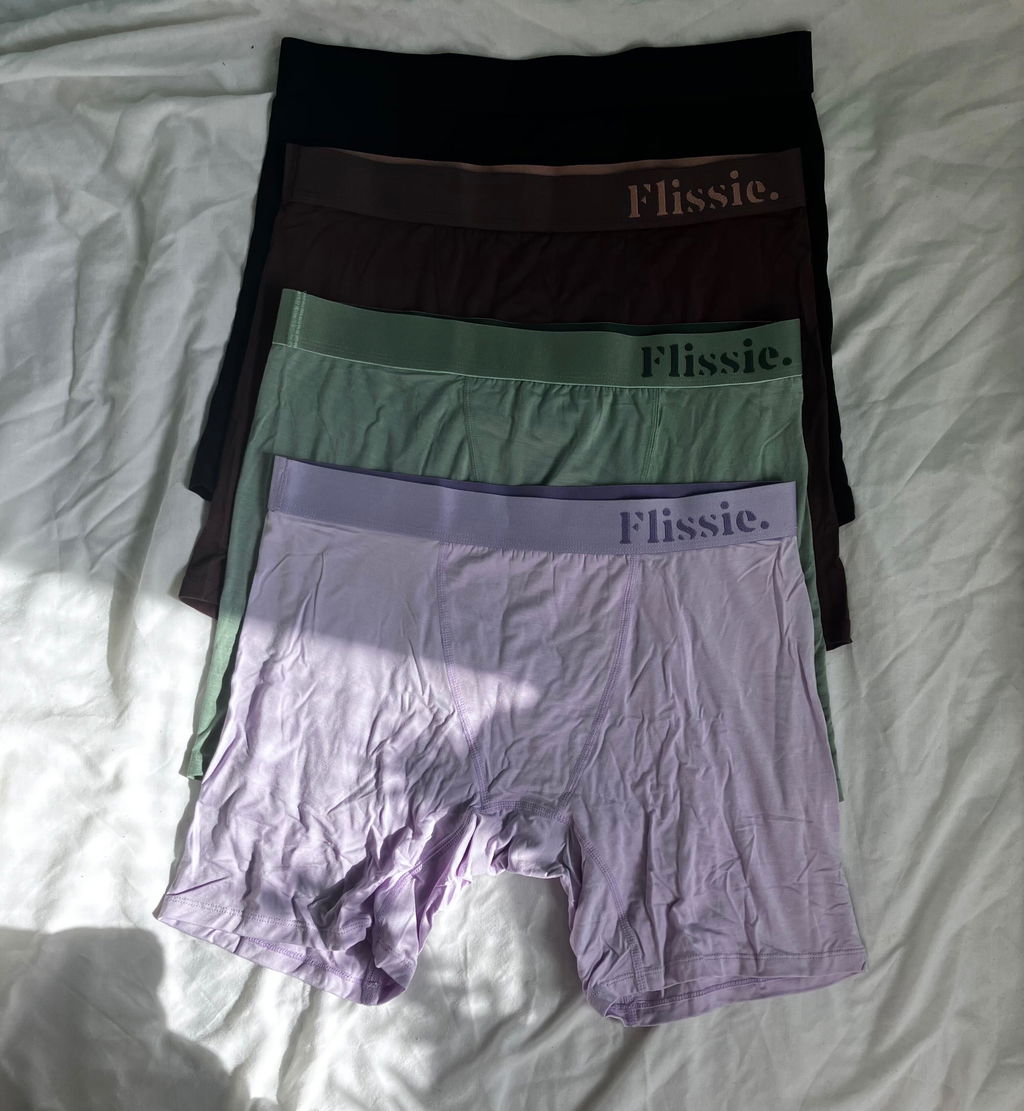
We're one of the twelve. Longer than women's boxer briefs, at 6 or 9 inches rather than 2 to 4, in bamboo viscose and UK 8 to 30 at one price. They exist to stop thigh chafing, which none of the shorter styles do.
Knicker style names are used loosely and inconsistently, and two brands will call the same cut different things. This is what each style actually is, who it tends to suit, and what to check before buying.
The 12 types of knickers at a glance
| Style | Coverage | Best for |
|---|---|---|
| Full briefs | Full seat, waist at or below the navel | Everyday, all-day comfort |
| High-waisted knickers | Full seat, waist at or above the navel | High-waisted trousers, postpartum, C-section recovery |
| Hipsters | Moderate, sits on the hip | Low-rise trousers, everyday |
| Bikini briefs | Moderate, higher leg cut | Everyday, warm weather |
| Tanga | Less than bikini, more than thong | Minimal coverage without a thong |
| Brazilian knickers | Full front, partial seat | Fitted clothing, fewer lines |
| Boyshorts | Full seat, 1 to 3 inch leg | Flatter line under trousers |
| Boxer shorts | Full seat, 6 to 9 inch leg | Stopping thigh chafing |
| Thongs | Front only, V-shaped back | No visible line under fitted clothes |
| G-strings | Minimal, T-shaped back | Bodycon and very fitted clothing |
| Period knickers | Varies, built-in absorbency | Periods, spotting, backup |
| Control briefs | Full, with compression | Smoothing under fitted clothing |
Full coverage styles
Full briefs
The default. Waist sits at or just below the navel, full coverage across the seat. Reliable, cheap and comfortable, and the style most people own most of.
Watch for: the leg elastic. On cheaper pairs it digs across the thigh and leaves a mark.
High-waisted knickers
Sits at or above the navel. Smooths the midsection rather than cutting across it, which is why it works under high-waisted trousers and fitted dresses.
Genuinely useful after a C-section, because the waistband sits well clear of the incision rather than on it. We cover that in our maternity knickers and postpartum guide.
Boyshorts
Square-cut with a short leg, usually 1 to 3 inches. More seat coverage than a brief and a flatter line under trousers, because the seam runs under the curve rather than across it.
Common misconception: boyshorts do not stop thigh chafing. A 1 to 3 inch leg does not reach where most thighs touch. More on that in our boyshorts guide.
Boxer shorts
The same family as boyshorts with considerably more leg, typically 6 to 9 inches. This is the only style long enough to stop thighs rubbing, which is the main reason people buy them.
Watch for: the leg band. A band that rolls into a rope at the top of the thigh is worse than no coverage, because the rope becomes the thing rubbing.
Moderate coverage styles
Hipsters
A hybrid of bikini and boyshort. Low-rise waistband sitting on the hip, moderate coverage, wider side panels than a bikini. Works well under low-rise trousers.
Bikini briefs
Higher leg cut than a full brief, waistband sitting lower on the hip. Less fabric, cooler in summer, and the most common style of knickers sold.
Tanga
Between a bikini and a thong. Narrower sides, partial seat coverage, but not a string. A reasonable middle ground if a thong is too little and a bikini is too much.
Brazilian knickers
Full coverage at the front, partial at the back, with wider side panels than a thong. Fewer visible lines than a bikini brief without going as minimal as a thong.
Minimal coverage styles
Thongs
Front panel with a narrow V or Y-shaped back. The usual answer to visible panty lines under fitted clothing.
Practical notes: choose a cotton or modal gusset over synthetic for everyday wear, and if you are new to them, start with cotton and wear them for shorter periods. Most general guidance suggests not sleeping in them and changing after exercise, which is the same advice that applies to any underwear worn during a sweaty activity.
G-strings
The most minimal. A small front panel with thin strings at the hip and a T-shaped back. Less fabric than a thong.
Best kept for occasions where complete invisibility matters, rather than everyday wear.
Function-led styles
Period knickers
Built-in absorbent layers, usually a moisture-wicking top layer, an absorbent core and a leak-resistant backing. Sold in absorbency levels from light through to overnight.
Practical notes: most people need five to seven pairs to get through a cycle. Rinse in cold water before washing, wash cool, skip fabric softener and air dry. Hot water sets stains.
Control briefs
Full coverage with compression built in, in light, medium and firm levels. Designed to smooth rather than reshape.
Watch for: sizing down to get more control. It does not work, it is uncomfortable, and it usually creates a line where the fabric ends.
How to choose
Start with the outfit. Fitted clothing points toward thongs, Brazilians or flat-seamed boxer shorts. Loose clothing means the style barely matters.
Then the problem you are solving. Visible lines, thighs rubbing, a waistband that digs, riding up. Each has a different answer, and it is usually the cut rather than the fabric.
Then the fabric. Cotton is breathable, cheap and forgiving in the wash but holds moisture. Bamboo viscose and modal are soft from the first wear and move moisture rather than absorbing it, at the cost of needing a cooler wash. Synthetics dry fastest but trap heat.
Look for OEKO-TEX Standard 100 on the label. It means the finished fabric has been tested for harmful substances, which is more useful than any claim about the raw material.
What we make
One of the twelve. Bamboo viscose boxer shorts with a 6 or 9 inch leg, UK 8 to 30, every size one price. They exist to stop thigh chafing, which none of the shorter styles do.
If that is not your problem, one of the other eleven is probably a better fit. See ours here.
Questions
What are the different types of knickers?
Twelve main styles: full briefs, high-waisted, hipsters, bikini briefs, tanga, Brazilian, boyshorts, boxer shorts, thongs, G-strings, period knickers and control briefs. They differ mainly in how much of the seat they cover and how high the waistband sits.
What are the most comfortable types of underwear?
Comfort is personal, but the styles people report most consistently are full briefs, hipsters and boxer shorts, all in a soft breathable fabric. What matters more than the style is whether the waistband digs and whether the leg opening cuts in.
How many pairs of knickers should I own?
Most people are comfortable with 10 to 14 pairs, which covers a week plus a buffer. We go through it properly in how many pairs you should own.
Which knickers have no visible panty line?
Thongs and G-strings show least, but a flat-seamed boyshort or boxer short often works just as well, because the seam sits under the curve of the buttock rather than across it. Look for flat or bonded seams rather than overlocked ones. We go through it in our no VPL guide.
What is the difference between a thong and a G-string?
Coverage. A thong has a V or Y-shaped back with a narrow strip of fabric. A G-string is a T-shape with a string rather than a strip, and thinner sides.
What is the difference between boyshorts and boxer shorts?
Leg length. Boyshorts run 1 to 3 inches, boxer shorts 6 to 9. That difference decides whether they reach the point where thighs touch, which is why one stops chafing and the other does not.
Does period underwear actually work?
For light to medium flow, generally yes, and many people use it as a backup on heavier days rather than alone. Absorbency varies a lot between brands, so check the stated capacity rather than the marketing.
What knickers are best for a bad back or postpartum recovery?
High-waisted, with a wide soft waistband rather than narrow elastic. After a C-section specifically, anything mid-rise tends to sit on the scar, which is the thing that hurts.